
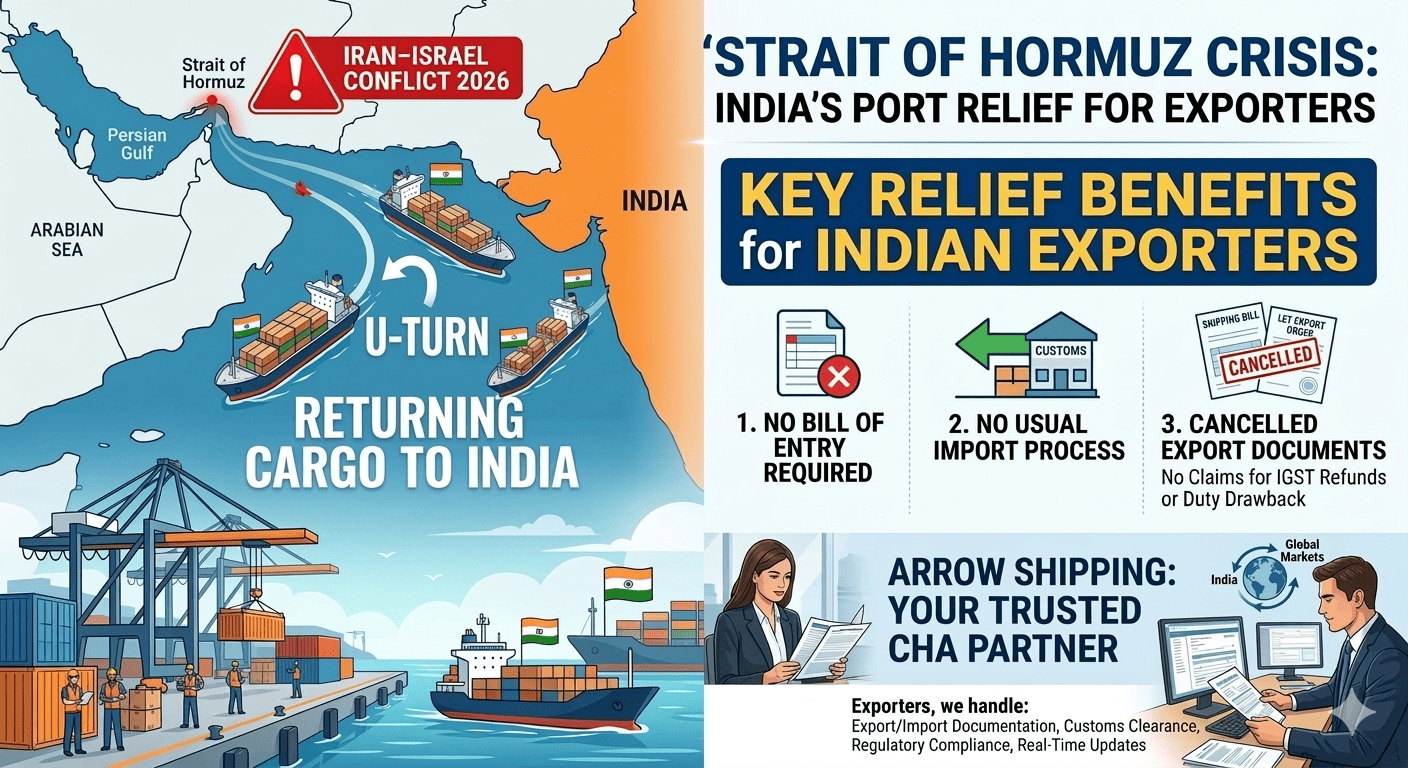
Strait of Hormuz Crisis: India Waives Port Procedures for Returning Export Cargo
Strait of Hormuz Crisis: What India’s New Port Relief Means for Exporters
Global trade depends heavily on stable maritime routes. One of the most important shipping corridors in the world is the Strait of Hormuz, which connects the Persian Gulf to international markets. Recently, disruptions linked to the Iran–Israel conflict escalation 2026 forced several vessels carrying Indian export cargo to turn back before reaching their international destinations.
To support exporters and shipping companies facing this unexpected situation, the Central Board of Indirect Taxes and Customs (CBIC) has introduced a temporary relief measure at Indian ports. This step aims to reduce paperwork and ensure smooth handling of cargo that was originally meant for export but had to return due to the maritime crisis.
Why Ships Were Forced to Return
The Strait of Hormuz is one of the busiest and most strategically important shipping lanes in the world. Any conflict or security threat in this region can immediately affect global shipping routes.
Due to rising tensions in West Asia, many shipping lines decided to reroute or recall vessels for safety reasons. As a result, containers that had already departed from Indian ports could not continue their journey and were forced to return to India.
This created a major challenge for exporters because the cargo had already completed export procedures, including documentation and customs clearance.
India’s Relief for Returning Export Cargo
To help traders and logistics companies manage this situation, the Central Board of Indirect Taxes and Customs allowed returning export cargo to be unloaded without going through the usual import process.
Under this relief measure:
- Ships can return to the same Indian port from where they departed.
- Containers can be unloaded without filing a Bill of Entry, which is normally required for imports.
- This applies only if the ship did not call at any foreign port during the voyage.
This decision significantly reduces administrative burden and speeds up the handling of returned cargo.
Customs Verification Process
Even though the import procedures are waived, customs authorities will still conduct necessary checks before releasing the cargo.
Officials will:
- Verify container numbers with the Shipping Bills.
- Inspect the seal integrity of the containers.
- Confirm that the cargo remained unopened during the voyage.
Once verified, the cargo can be safely returned to the exporters.
Cancellation of Export Documents
Since the cargo never reached foreign buyers, the export documentation will be cancelled.
This includes:
- Shipping Bills
- Let Export Order (LEO)
The purpose of cancelling these documents is to ensure that exporters do not receive export incentives for shipments that were never delivered internationally.
This prevents claims for benefits such as:
- IGST refunds
- Duty drawback
Role of the Customs Digital System
The customs electronic platform ICEGATE will manage the cancellation of shipping bills and share the information with key authorities including:
- Reserve Bank of India
- Directorate General of Foreign Trade
This coordination ensures that export incentive claims are not processed for these returned shipments.
Until the new system facility becomes fully operational, customs offices will temporarily maintain records manually and update them later in the digital system.
Important Exception
The circular also highlights an important condition.
If a vessel stopped at a foreign port before returning to India, even if the cargo was not unloaded, the shipment will still be treated as exported under existing regulations.
This rule affects documentation and export incentive eligibility.
What This Means for Exporters
This relief measure provides several benefits for exporters and shipping companies:
- Faster handling of returned cargo
- Reduced paperwork and compliance burden
- Clear rules regarding export incentives
- Operational relief during geopolitical disruptions
In uncertain global trade conditions, such measures help maintain stability for exporters.
How Arrow Shipping Supports Exporters
At Arrow Shipping, we understand that international trade can be affected by unexpected global events. Situations like the Strait of Hormuz disruption highlight the importance of having an experienced customs and logistics partner.
As a professional Custom House Agent (CHA) service provider, Arrow Shipping assists clients with:
- Export and import documentation
- Customs clearance procedures
- Regulatory compliance
- Cargo handling during disruptions
- Real-time updates on trade regulations
Our goal is to ensure that exporters experience minimal delays and smooth cargo movement, even during challenging global situations.
Conclusion
The recent disruption in the Strait of Hormuz has shown how global conflicts can quickly affect international trade. India’s decision to relax port procedures demonstrates a proactive approach to protecting exporters and supporting the shipping industry.
With the right logistics expertise and regulatory guidance, businesses can navigate these challenges effectively.
At Arrow Shipping, we remain committed to helping our clients manage global trade with confidence, efficiency, and compliance.